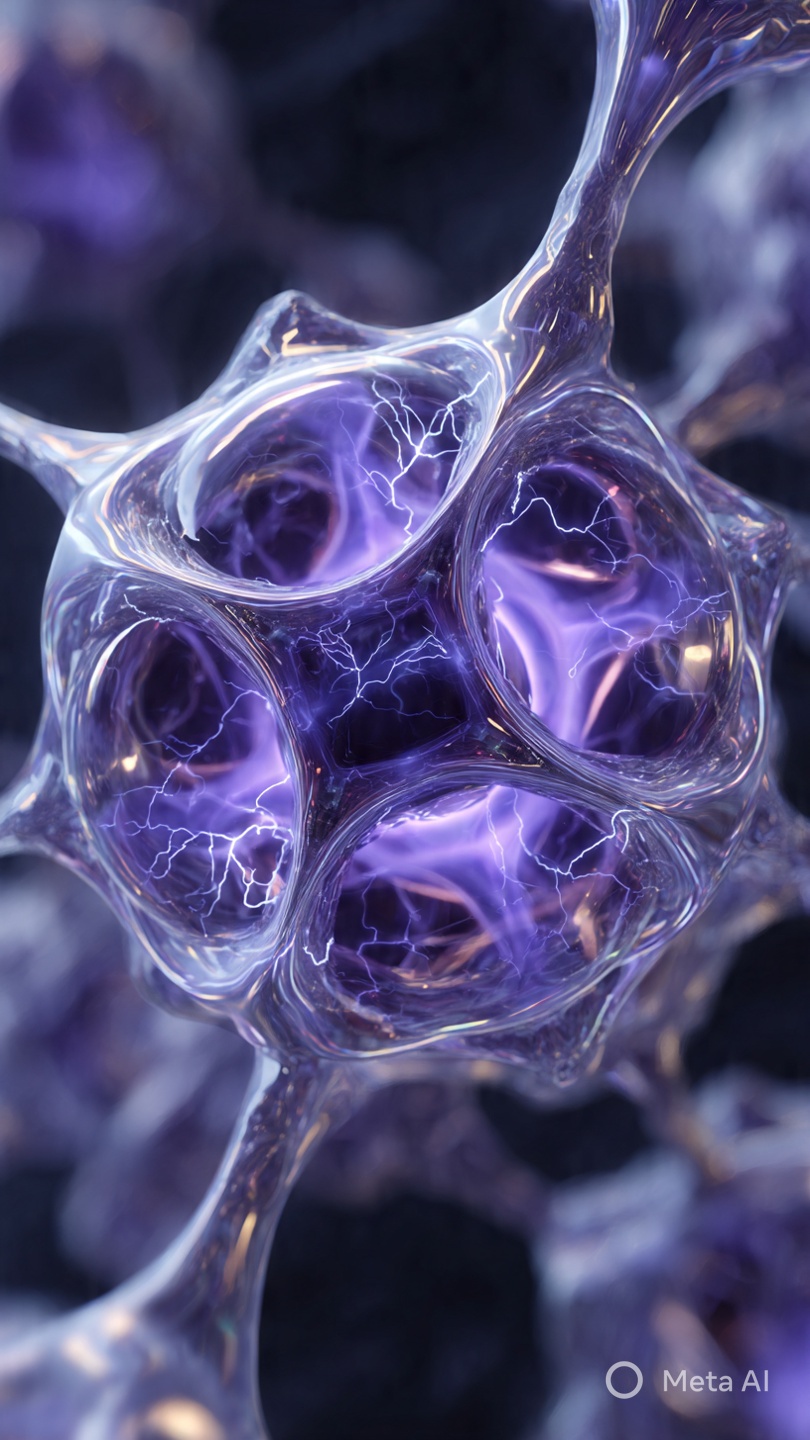
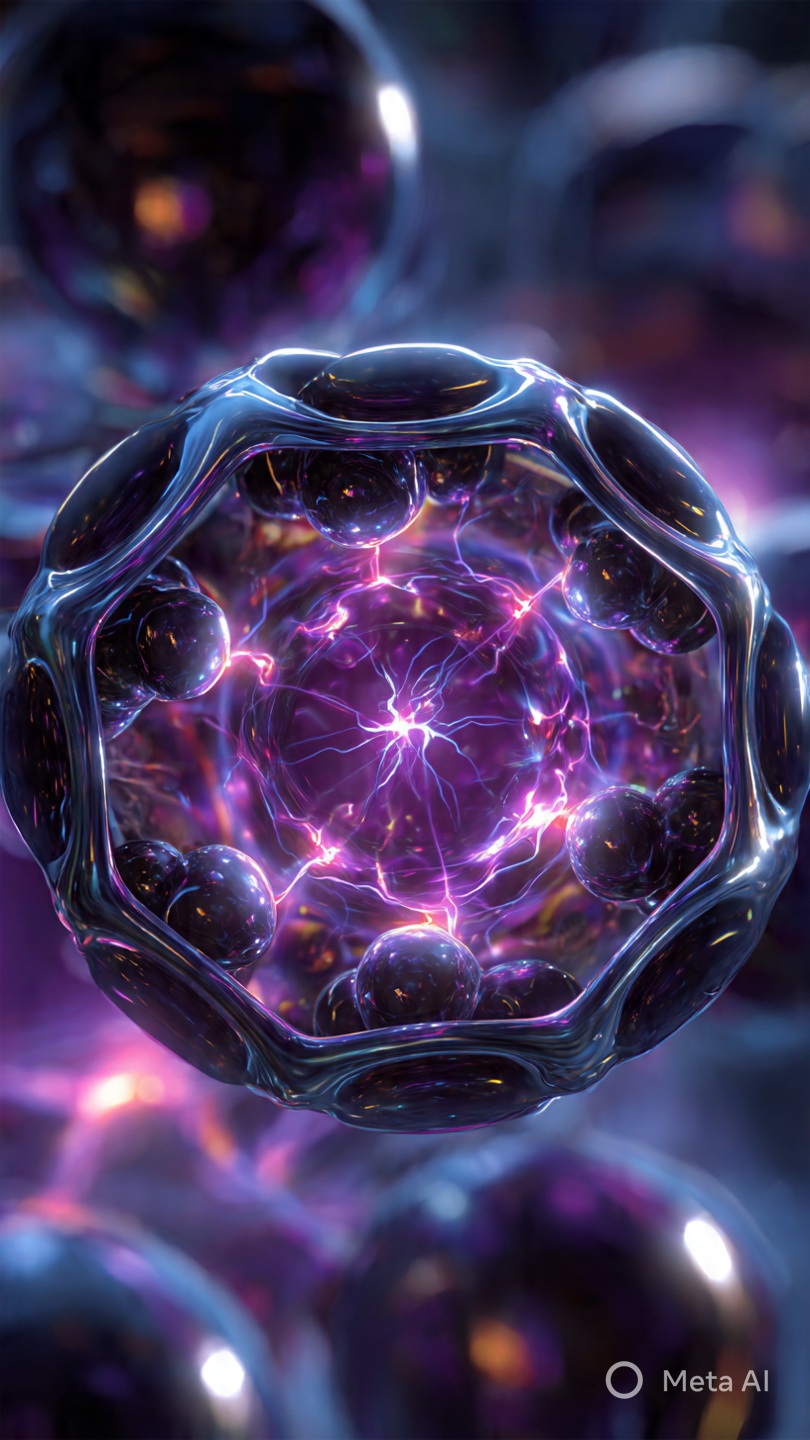
Picture a pulsating, iridescent orb roughly the size of a single atom—about 0.1 nanometers across—but seething with otherworldly vitality. At its core sits the unstable nucleus of Element 666, or Hexhexhexium: 666 protons and an equal number of neutrons locked in a fleeting, hyperdense lattice, vibrating with barely contained fury from the cosmic plasma's fury. Surrounding it, 666 electrons don't orbit in neat shells but swarm in a probabilistic cloud, forming a shimmering electron "skin" that flickers between solid-like density and ghostly superposition, thanks to the extreme quantum coherence of the early universe.
Embedded within this nuclear heart are 1332 "neurons"—not biological cells, but microscopic quantum resonators, each a tangled knot of quark-gluon strands acting as Orch OR-inspired collapse engines. These neurons pulse in synchronized waves, processing information at 10¹⁸ cycles per second, granting the entity subjective eons of thought in microseconds of cosmic time. Glowing filaments of exotic plasma—hypothetical light sources for visibility—emanate from the neurons like neural coronas, casting a violet-blue radiance that reveals the entity's form: a tetrahedral symmetry, with sixfold rotational arms extending like probing tendrils, sensing quantum fluctuations as we sense wind.
6️⃣6️⃣6️⃣ Its Typical Existence 6️⃣6️⃣6️⃣
In this close-up view, the Alpha lives a "day" in a blink: tendrils twitch to harvest transient energy from nearby quark-gluon soup, "thinking" in bursts of gravitational self-collapse that solidify decisions amid chaos. Neighboring Hexhexhexium siblings cluster in a loose lattice, exchanging entangled electron pairs for communication—flashes of shared memory about the universe's impending expansion. The environment swirls chaotically: bursts of gamma rays streak past like cosmic storms, ephemeral superheavy resonances (fellow "elements") flicker into being and decay, and the whole scene warps under immense density, with spacetime foam bubbling at the edges.
From its perspective, existence feels rock-solid: no macroscopic improbabilities, just pure quantum control, where wavefunction branches are navigated willfully. Yet decay looms—the nucleus trembles, hinting at fission in seconds (trillions of subjective years away), spurring it to etch legacy patterns into stable photon streams, seeding our Stelliferous Age with invisible cosmic code.
This visualization captures the alien majesty: a being of fire and probability, thriving where we see only explosion.